
Introduction
The Specialized Investment Fund is one of the most interesting additions to India's investment landscape in recent years. With the promise of long-short strategies, derivative exposure, and returns uncorrelated to plain market direction. SIFs can sound very attractive, especially to investors who have outgrown regular mutual funds.
But attractive and appropriate are two different things.
SIF is not a smarter mutual fund. It is a fundamentally different product which uses derivatives, can bet against stocks, and operates with significantly more complexity than a standard equity or debt scheme. Before you commit even the minimum ₹10 lakh, there are five things every investor should carefully examine.
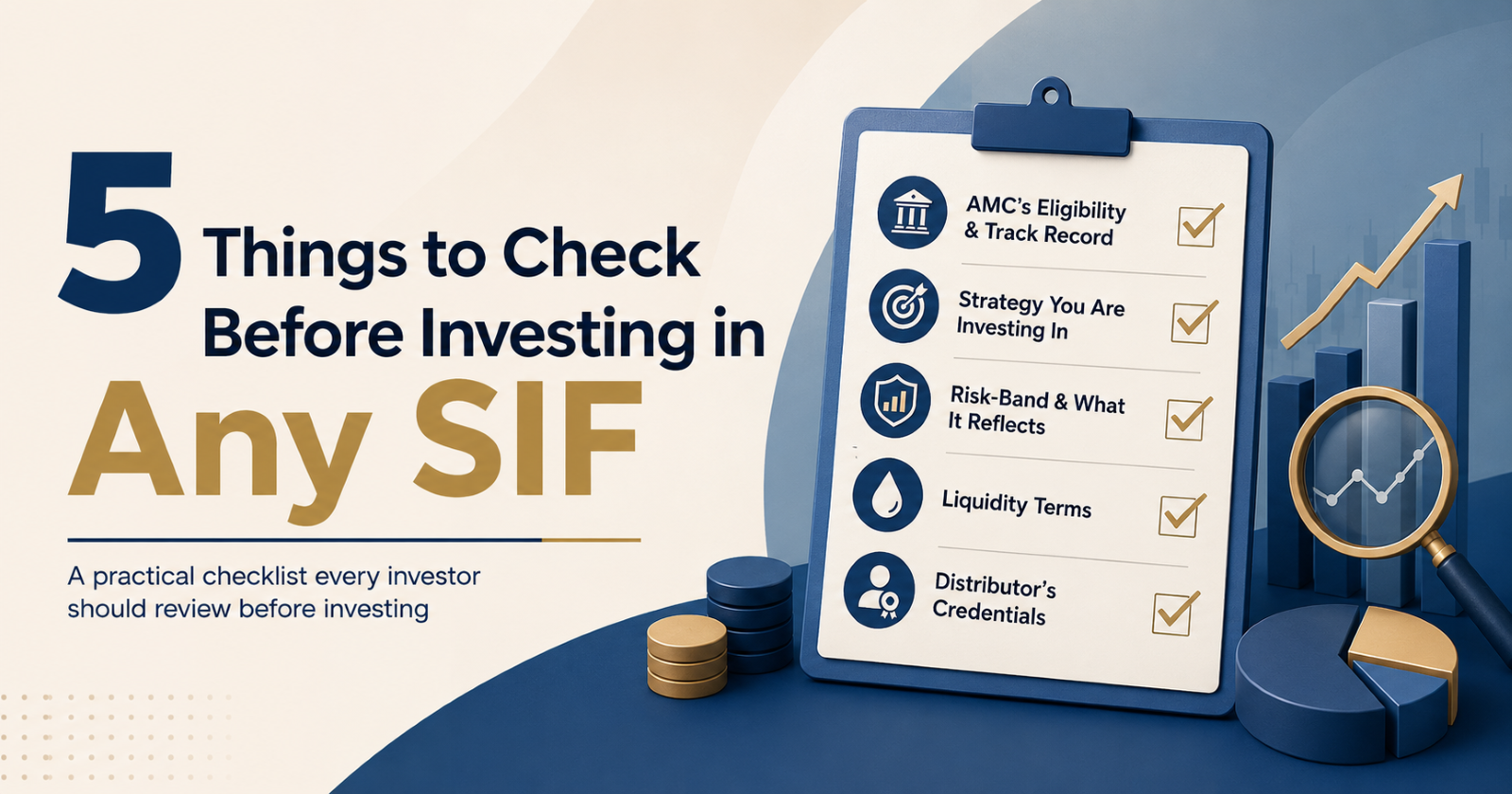
1. Check the AMC's Eligibility and Track Record
Not every AMC is allowed to run an SIF, SEBI has set specific eligibility criteria for a reason. Before investing, verify that the AMC has received formal SEBI approval to establish an SIF, and understand which route they qualified through.
If the AMC qualified via Route 1 (the standard track record route), it means they have at least 3 years of operations and an average AUM of ₹10,000 crore or more over the preceding 3 years. That is a meaningful signal of institutional depth and operational maturity. If they qualified via Route 2 — the alternate route for newer AMCs — the quality of the appointed CIO becomes even more important. Route 2 AMCs lean entirely on the expertise of their hired professionals rather than the AMC's own institutional history.
Either way, look at who is managing the SIF, how long they have managed money, what AUM they have handled, and whether the AMC has faced any regulatory action from SEBI in the last 3 years.
2. Check Which Strategy You Are Actually Investing In
SIF is a category containing up to seven distinct types of investment strategies across equity, debt, and hybrid. These strategies behave very differently from each other.
An Equity Long-Short Fund, for instance, maintains at least 80% in equities but can simultaneously short up to 25% of its net assets through derivatives. A Debt Long-Short Fund, on the other hand, is an interval strategy investing in debt instruments across durations with short positions via exchange-traded debt derivatives. A Hybrid Long-Short Fund blends both equity and debt with short exposure on either side.
Before investing, read the Investment Strategy Information Document (ISID) and understand precisely what the strategy is trying to do, how it makes money, and under what market conditions it could lose money. Pay particular attention to the scenario analysis section of the ISID, which SEBI mandates must depict expected losses under different market movements.
3. Check the Risk-Band and What It Actually Reflects
Every SIF investment strategy is assigned a Risk-Band which is a five-level indicator from Level 1 (lowest risk) to Level 5 (highest risk). This is evaluated monthly and disclosed on both the AMC's website and AMFI's website within 10 days of each month-end.
But unlike a basic riskometer, the Risk-Band for an SIF must account for derivative exposure, short positions, and liquidity risk. A strategy that sits at Risk Band 3 today may move to Risk Band 4 if the fund manager increases derivative exposure or shifts to lower-rated debt instruments.
Two things to do here: first, check the current Risk-Band of the strategy you are considering. Second, check how many times the risk band has changed over the past year. A strategy that has frequently shifted its risk band is not necessarily bad, but it does tell you something about how actively the portfolio is being managed and how stable the risk profile is.
4. Check the Liquidity Terms
SIF strategies are not as liquid as regular open-ended mutual funds, and the liquidity terms vary significantly across strategy types.
Equity strategies offer daily redemption at minimum. But debt strategies are interval funds with a minimum redemption frequency of once a week. Hybrid strategies allow redemption at least twice a week. On top of this, AMCs are permitted to impose a notice period of up to 15 working days before processing your redemption. In such cases, your redemption will be processed at the NAV at the end of the notice period, not the date you submitted the request.
Close-ended and interval SIF strategies must be listed on recognised stock exchanges, which provides a secondary market exit. But exchange liquidity for such instruments can be thin, and the market price may differ from NAV.
Minimum Investment Threshold rule: if your portfolio value falls below ₹10 lakh due to a redemption you initiate ( an active breach) , the transaction will be blocked. And if it falls below ₹10 lakh due to NAV decline (a passive breach), you can only redeem the entire remaining amount, not a partial withdrawal.
5. Check Your Distributor's Credentials
This one is easy to overlook, but SEBI has made it mandatory for a reason. Any distributor or financial advisor who sells you an SIF product must have passed the NISM Series-XIII: Common Derivatives Certification Examination. This is over and above the standard NISM certifications required to distribute mutual funds.
The reason is straightforward: SIF strategies involve derivatives, short selling, and complex exposure calculations and a distributor who does not understand how futures exposure is computed, how offsetting works, or what a passive breach of the minimum threshold cannot adequately explain the risks to you.
Before signing anything, ask your advisor or distributor directly whether they hold the NISM Series-XIII certification. AMCs and AMFI are required to verify and enforce this, but the first line of defence is you asking the question.
A Quick Checklist Before You Invest
To summarise everything above, run through these questions before committing your money:
Has the AMC received SEBI's formal approval to launch an SIF? Have you read the ISID of the specific strategy, including the scenario analysis? What is the current Risk-Band, and how many times has it changed in the past year? What are the exact redemption frequency and notice period terms for this strategy? Does your distributor hold the NISM Series-XIII certification?
If you have clear, satisfactory answers to all five, you are making an informed decision. If any answer is vague or unavailable, dig deeper before investing.
Conclusion
The ability to access long-short strategies, sector rotation, and dynamic asset allocation within a regulated, pooled framework is a meaningful step forward. But with that flexibility comes complexity which demands research and awareness of what you are investing in.
In any investment, the best protection you have is your own understanding of what you own.