
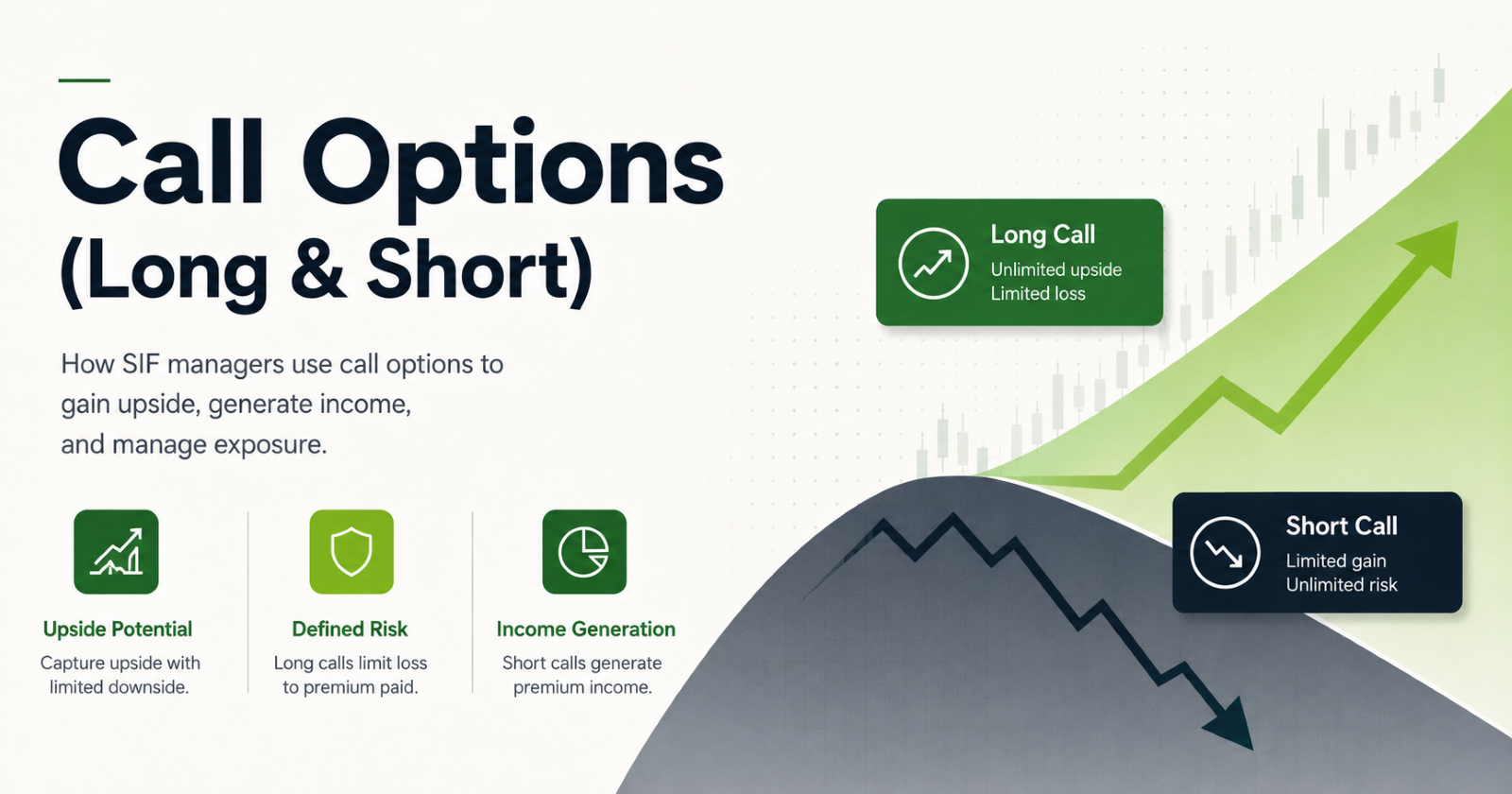
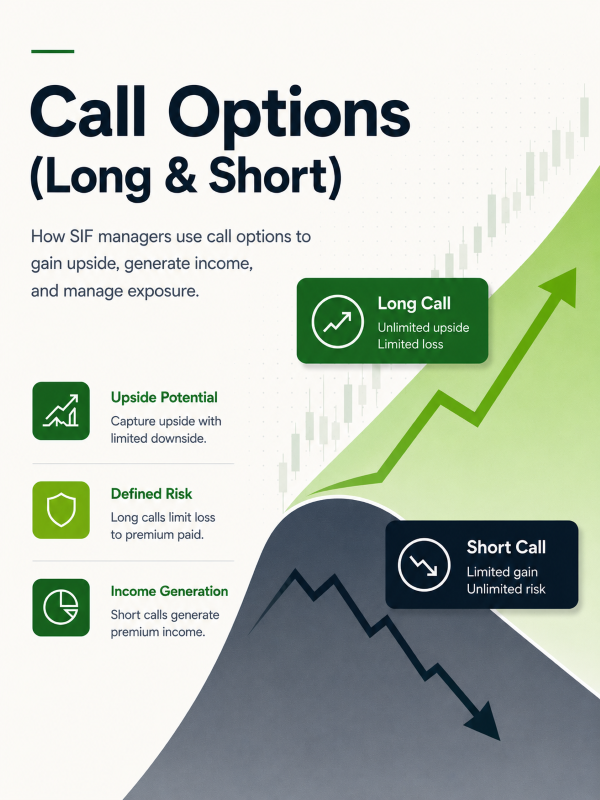
A call option gives the buyer the right, but not the obligation to purchase an underlying asset at a fixed price (called the strike price) before or on the expiry date. The buyer pays a premium upfront for this right. The seller of the call collects that premium and takes on the obligation to sell if the buyer exercises.
In an SIF, managers use call options on both sides. Buying calls to gain upside exposure with limited downside. Selling calls to generate income or cap a position's upside.
Long vs Short
Long Call | Short Call | |
Profit when | Price rises above strike + premium | Price stays below strike |
Loss when | Price stays below strike | Price rises sharply above strike |
Max loss | Premium paid | Unlimited (uncapped upside risk) |
Max gain | Unlimited | Limited to premium collected |
When Does an SIF Manager Use This?
Long Call: When the manager has a bullish view but wants to limit downside to just the premium paid rather than deploying full capital into the stock. It is capital-efficient, the same directional bet at a fraction of the cost of buying the stock outright.
Per the SEBI circular, exposure for options bought is calculated as: Option Premium Paid × Lot Size × Number of Contracts, not the full notional value.
Short Call: When the manager already holds a stock and believes it will not rise significantly in the near term. Selling a call against an existing position generates premium income. This is the Covered Call strategy, but the standalone short call is also used when the manager has a neutral to bearish directional view on a stock not held in the portfolio.
Per the SEBI circular, exposure for options sold is calculated as: Market Price of Underlying × Lot Size × Number of Contracts i.e. the full notional value, not just the premium. This means short calls consume significantly more of the 25% unhedged short exposure limit than long calls consume of gross exposure.
How It Plays Out
Setup: Manager buys a call on Stock A at strike ₹2,500, premium ₹90 per share, lot size 500. Separately, sells a call on Stock B at strike ₹1,000, premium ₹40, lot size 400.
Scenario | Long Call (Stock A) | Short Call (Stock B) |
Price rises sharply | Gains: unlimited upside beyond strike | Losses: obligation to sell below market |
Price stays flat | Loses premium paid (₹45,000) | Keeps full premium (₹16,000) |
Price falls | Only loses premium | Keeps full premium |
The asymmetry is the defining feature here. The long call buyer has defined, limited loss and unlimited gain. The short call seller has defined, limited gain and theoretically unlimited loss. That asymmetry is precisely why short calls in SIF consume more gross exposure than long calls.