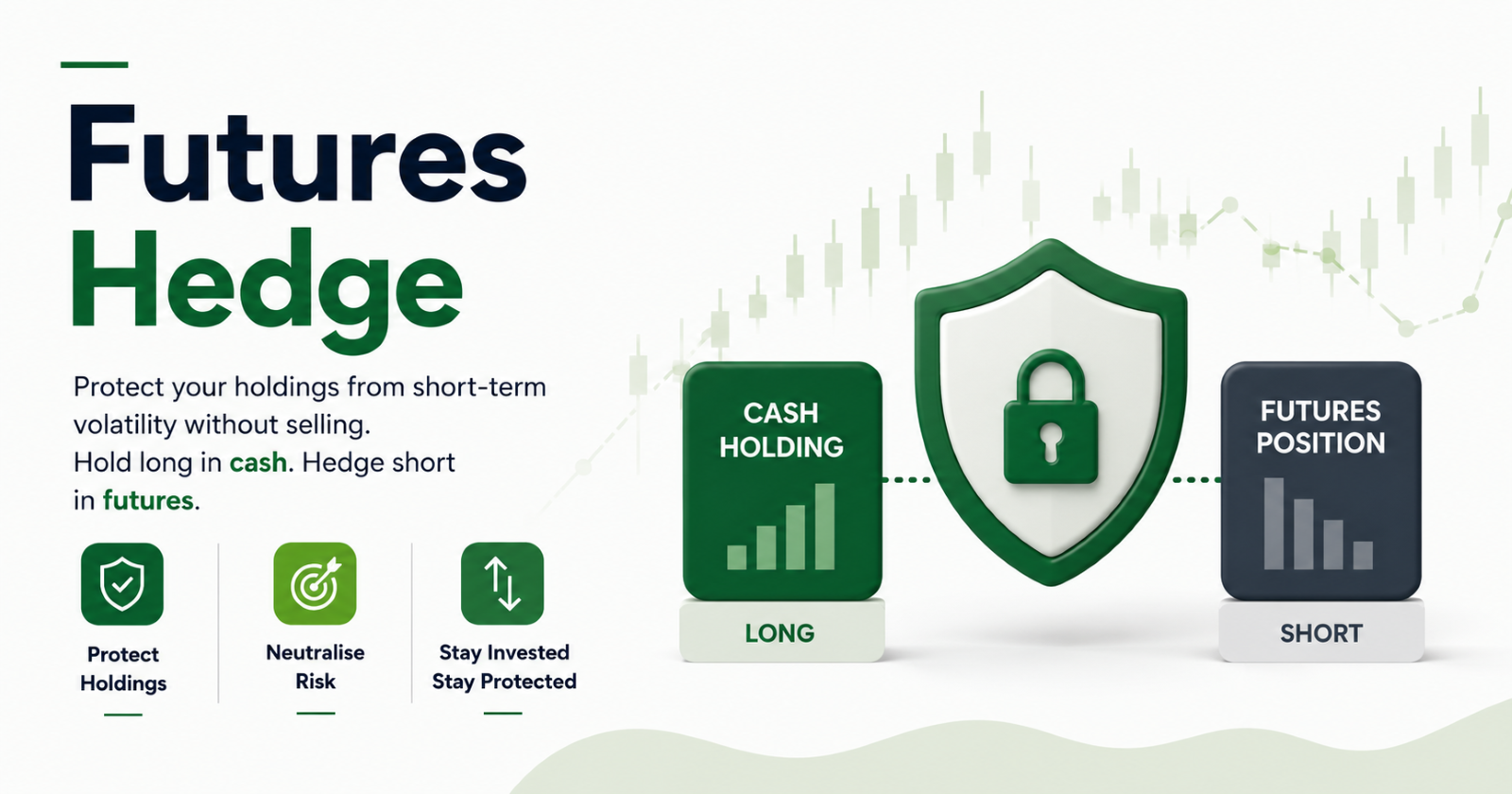
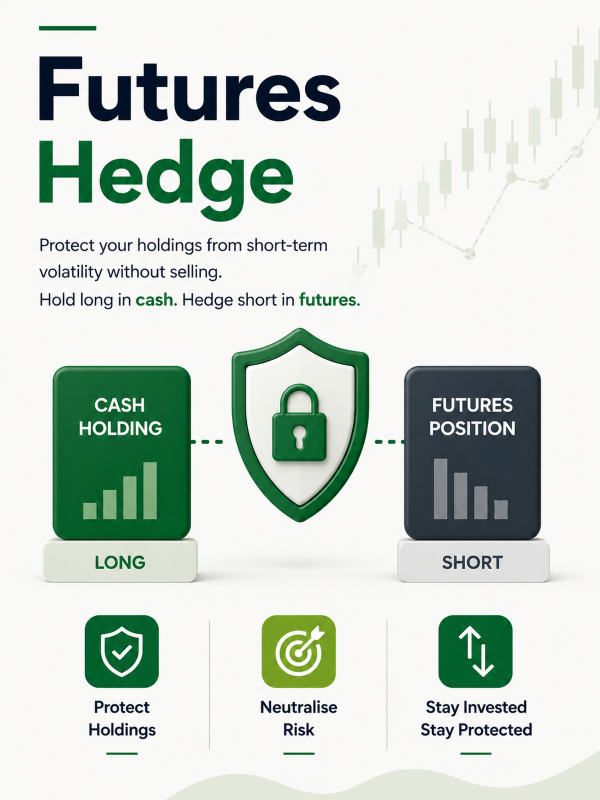
When a fund manager holds a stock or a basket of stocks in the portfolio and wants to protect against a potential short-term fall, without selling the position, they short futures on the same underlying. The loss on the cash position if the stock falls is offset by the gain on the short futures position.
This is different from an unhedged or normal short futures position, where the manager has no underlying holding. Here, the futures position exists solely to neutralise the risk of something already owned.
When Does an SIF Manager Use This?
A manager uses a futures hedge when they want to retain a long-term holding but expect short-term turbulence (ahead of an earnings announcement, a macro event, or a period of broad market uncertainty). Rather than exiting and re-entering the position, which involves transaction costs and potential tax impact, the futures hedge temporarily neutralises the price risk while keeping the holding as it is.
The SEBI circular explicitly separates derivative exposure taken for hedging and portfolio rebalancing from the 25% unhedged short exposure limit. A futures hedge does not consume the 25% unhedged short limit. This means a manager can run a full 25% unhedged short book and still layer hedges on top of existing positions without breaching any limit.
The circular also permits offsetting between a cash position and a derivative position on the same underlying security. This means the net exposure of a hedged position, stock held long in cash, shorted via futures, is counted as the residual after offsetting, not as two separate gross positions added together.
How It Plays Out
Setup: Manager holds Stock A worth ₹10 crore in the cash portfolio. Concerned about near-term volatility, takes a short futures position on Stock A at ₹2,500, lot size 500, shorting contracts worth approximately ₹10 crore to fully hedge the position.
Scenario | Cash Position (Long Stock A) | Futures Position (Short Stock A) | Net Impact |
Stock falls 10% | Loses ₹1 crore | Gains approx ₹1 crore | Neutral |
Stock rises 10% | Gains ₹1 crore | Loses approx ₹1 crore | Neutral |
Stock stays flat | No change | No change | Neutral |
The hedge neutralises both upside and downside while it is active. This is the trade-off: the manager sacrifices potential gains during the hedged period in exchange for protection against losses. A partial hedge i.e. shorting futures worth only 50% of the cash position, preserves some upside while reducing downside proportionally.