Imagine you have a strong view on a stock, you are convinced it is going up over the next month. But instead of buying the stock today and tying up the full capital, you enter into a contract that lets you lock in today's price and settle later. That contract is a futures contract.
A futures contract is a standardized agreement to buy or sell an underlying asset (a stock, an index, or a debt instrument) at a predetermined price on a future date. The underlying does not change hands immediately. What changes hands is the obligation to transact at that agreed price when the contract expires.
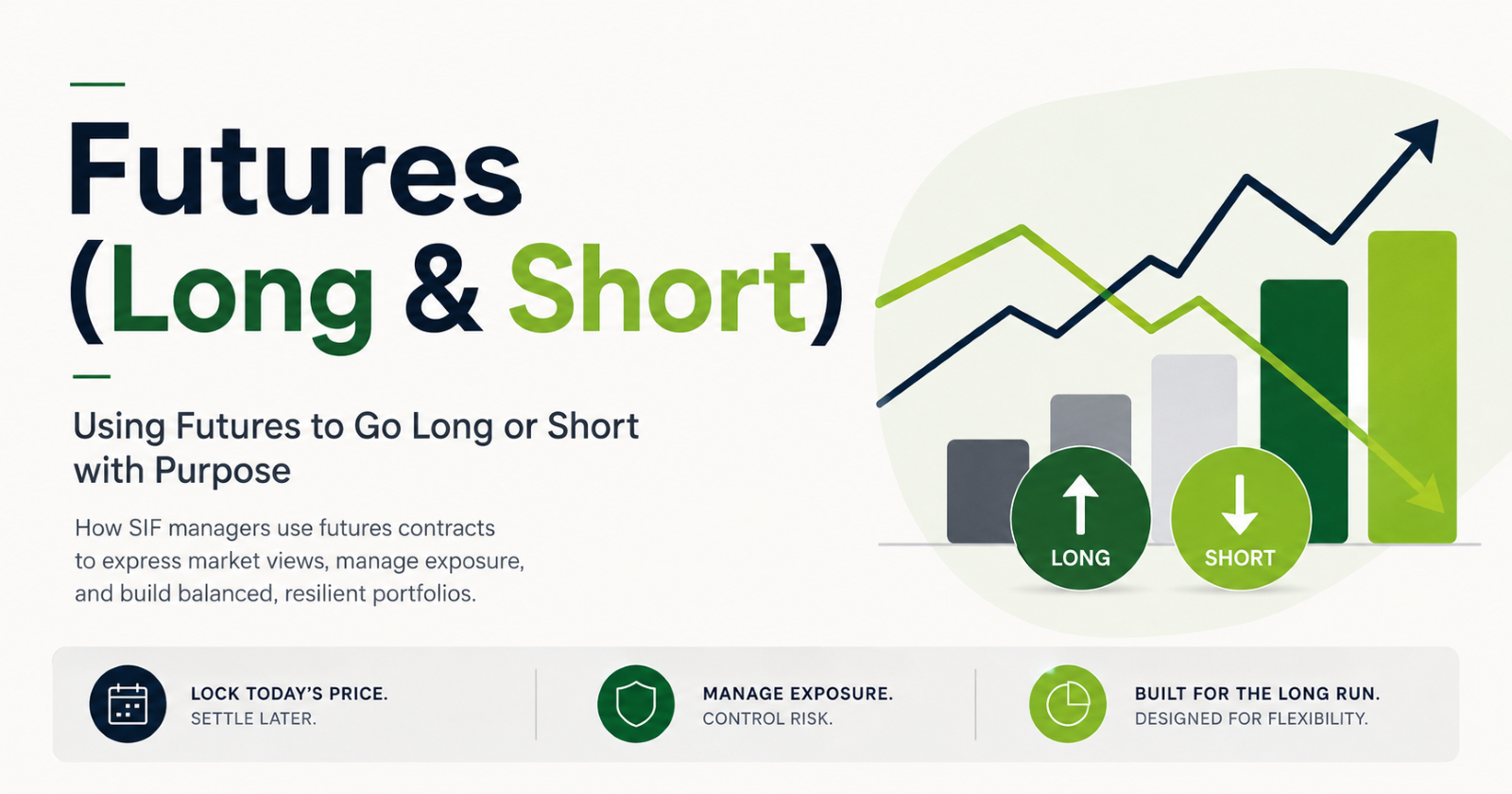
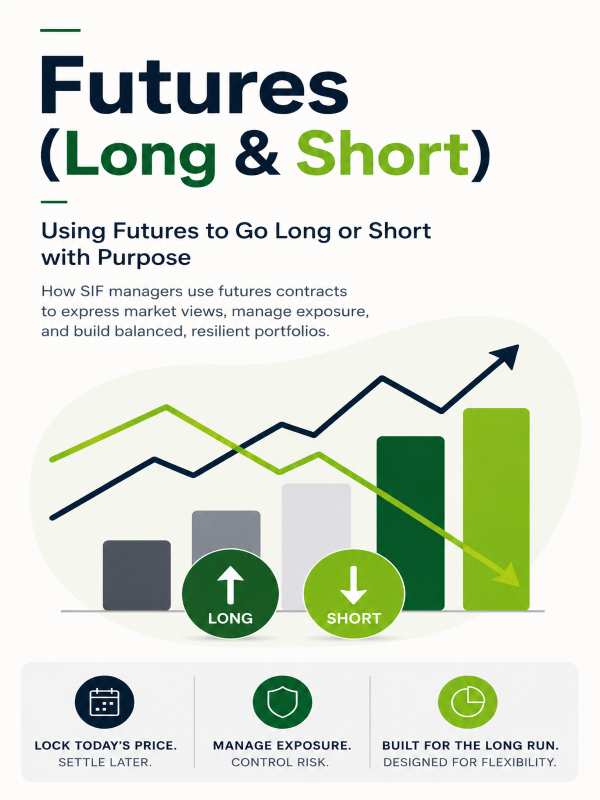
In an SIF, fund managers use futures on both sides, going long when they expect prices to rise, and going short when they expect prices to fall. Both are equally valid tools, and both are specifically permitted under the SIF framework through exchange-traded derivative instruments.
Long vs Short
Long Futures | Short Futures | |
Position | Agrees to buy the underlying at a fixed price on a future date | Agrees to sell the underlying at a fixed price on a future date |
Profit when | Underlying price rises above the futures price | Underlying price falls below the futures price |
Loss when | Underlying price falls below the futures price | Underlying price rises above the futures price |
When Does an SIF Manager Use This?
Going Long on Futures
A manager may use long futures when they want to gain exposure to a stock or index quickly, without immediately deploying full capital into the cash market. It is also used to increase exposure to a position the fund already holds, or to gain market exposure while keeping cash available for other opportunities.
In an SIF, long futures exposure is included in the total gross exposure calculation. As per the SEBI circular, exposure for long and short futures is calculated as: Futures Price × Lot Size × Number of Contracts. The cumulative gross exposure across all instruments (cash and derivatives) cannot exceed 100% of the net assets of the investment strategy.
Going Short on Futures
This is where SIF meaningfully separates itself from a regular mutual fund. A manager uses short futures when they have a bearish view on a specific stock, index, or sector. Regular mutual funds cannot do this.
SEBI permits unhedged short exposure through exchange-traded derivatives of up to 25% of net assets, specifically for purposes other than hedging and portfolio rebalancing. Short futures are the most direct instrument for executing this view. In equity strategies like the Sector Rotation Long-Short Fund, if a manager goes short on a sector via futures, the circular requires that all stocks within that sector held in the portfolio must be treated as short positions.
How It Plays Out
Example setup: SIF fund with ₹100 crore AUM. Manager takes a long futures position on Stock A at ₹2,500 (lot size 500 units = ₹12.5 lakh per contract) and a short futures position on Stock B at ₹1,000 (lot size 400 units = ₹4 lakh per contract).
Market scenario | Long Futures on Stock A | Short Futures on Stock B |
Stock rises 10% | Gains ₹1.25 lakh per contract | Loses ₹0.4 lakh per contract |
Stock falls 10% | Loses ₹1.25 lakh per contract | Gains ₹0.4 lakh per contract |
Stock stays flat | Minimal gain or loss | Minimal gain or loss |
Both stocks fall 10% | Long book loses | Short book gains, partially offsets |
Both stocks rise 10% | Long book gains | Short book loses, partially offsets |
The real power of combining both positions in an SIF is visible in the last two rows. The short book does not need to be right on its own, it serves as a structural counterweight to the long book in adverse market conditions.
One important note on exposure offsetting: the SEBI circular specifically permits offsetting between cash and derivative positions on the same underlying security, and between two derivative positions on the same underlying. This means if a fund holds Stock A in the cash market and also holds a short futures position on Stock A, the net exposure is calculated after offsetting, not as a double count.