
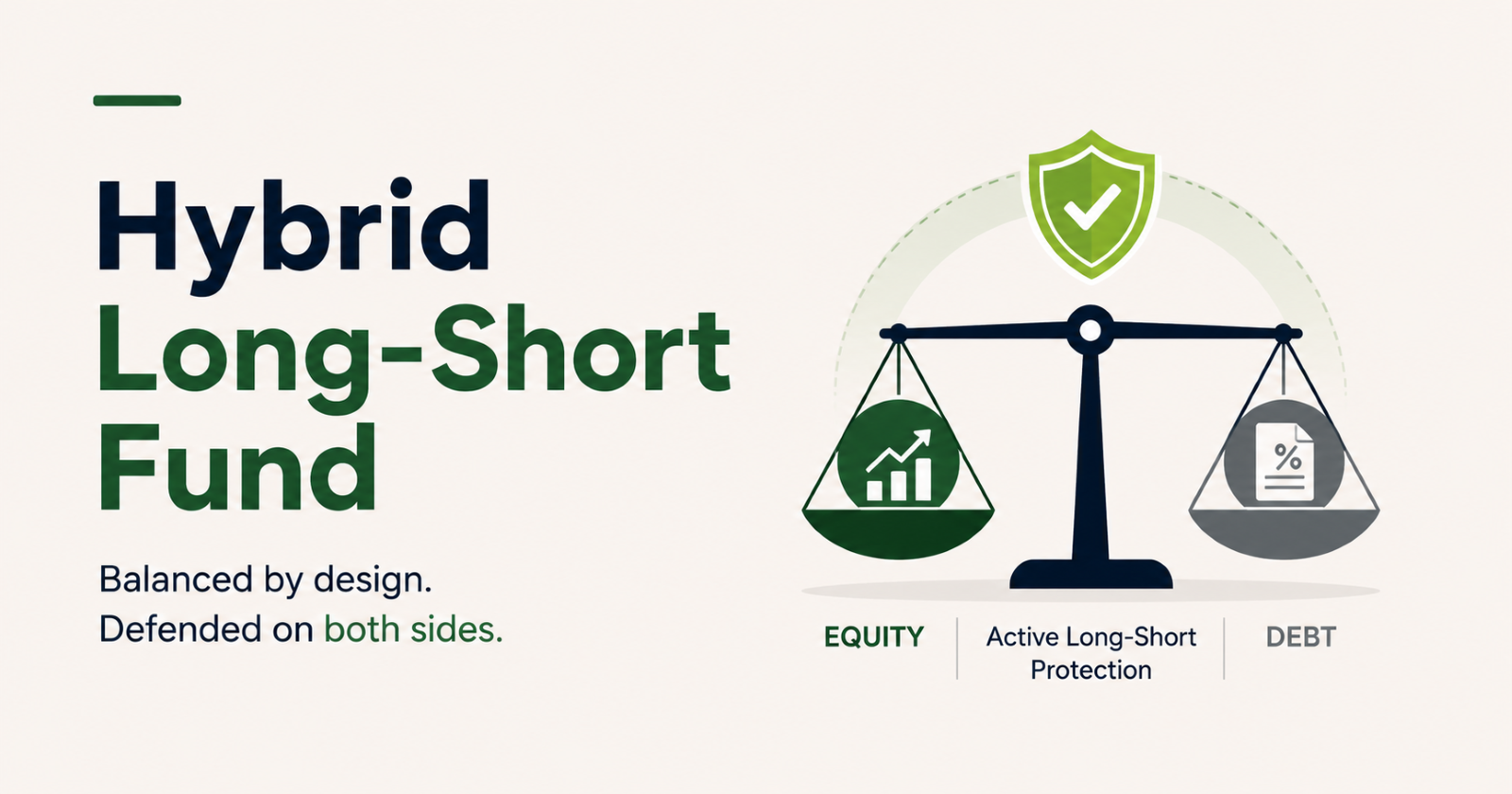
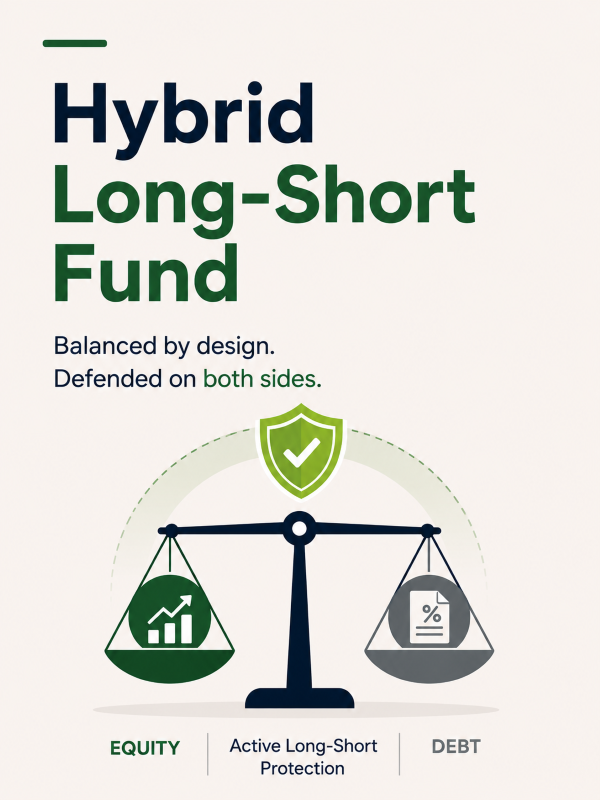
The balanced fund has been used for Indian investor portfolios for decades. Equity for growth, debt for stability, rebalanced periodically. But anyone who held a traditional balanced fund through 2008, 2020, or the 2022 rate shock knows the limitation of when equity falls and rates rise simultaneously, there is nowhere to hide. Both legs of the portfolio hurt at the same time, and the manager's only tool is to wait it out.
The Hybrid Long-Short Fund keeps the familiar balanced structure but adds something traditional hybrid funds have never had which is the ability to actively defend both legs.
What This Fund Does Differently
The mandate requires a minimum 25% in equity and equity-related instruments and a minimum 25% in debt instruments. Beyond these floors, the manager has discretion over the remaining allocation.
The short book allows up to 25% of net assets in unhedged derivative positions across both equity and debt. Critically, this is a combined limit, the manager must decide how to deploy that 25% between the two asset classes based on where the bearish conviction is stronger at any given time.
Among the seven SIF strategies, the Hybrid Long-Short Fund occupies a specific niche. It is less concentrated than the Sector Rotation Fund, less unconstrained than the Active Asset Allocator, and more accessible in concept than the pure debt strategies.
Where This Strategy Shines
Think 2022, when rising rates crushed bond prices while equity markets corrected sharply. A Hybrid Long-Short manager in that environment could short the long-duration debt dragging down the fixed income side, while shorting the most vulnerable equity sectors on the other side. Both legs of the short book work together, defending the portfolio from two directions at once.
However, the 25% short book is shared between equity and debt; it is 25% combined. In an environment where both asset classes are falling simultaneously, the manager is forced to choose where to deploy that limited short capacity. They cannot fully defend both sides at the same time, which means one leg of the portfolio will always remain more exposed than the other during a broad market stress event.
It is also worth noting that with minimum allocations of just 25% each to equity and debt, the fund has wide discretion over the remaining 50%, which makes the strategy only as stable as the allocation decisions being made with that unconstrained portion.