

For most of India's investment history, the only way to participate in markets was to go long, buy a stock, hold it, and hope it goes up. If you were wrong, you lost money. There was no structural way to profit from a falling stock or hedge a specific sector bet within a regulated and accessible investment product like mutual funds.
The arrival of the Specialized Investment Fund framework in April 2025 marks the first time SEBI has formally permitted long-short strategies within a pooled, mutual fund-regulated structure accessible at ₹10 lakh. To understand why this matters, it helps to understand what long-short strategies actually do and why India's investment ecosystem is now ready for them.
What a Long-Short Strategy Actually Does
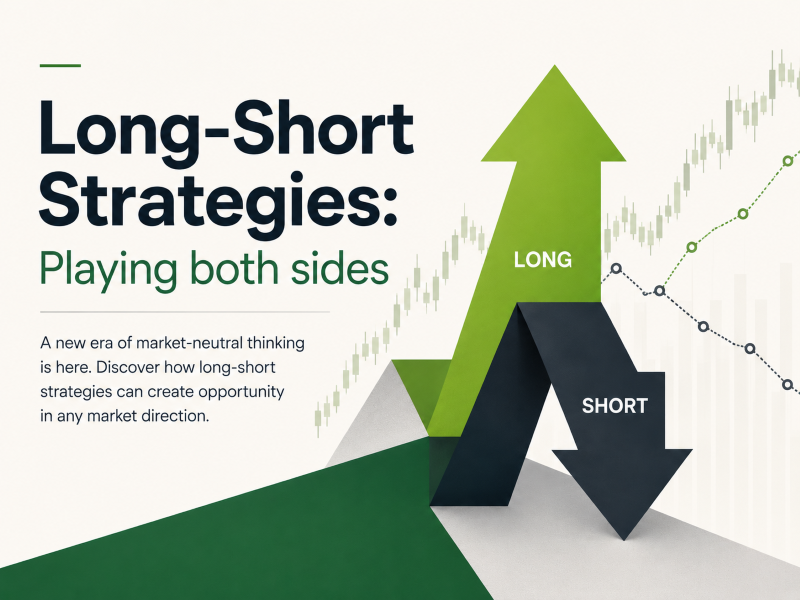
A long-short strategy holds two books simultaneously. The long book buys securities the manager believes will go up. The short book bets against securities the manager believes will go down through derivative instruments.
In a rising market, the long book drives gains while the short book may drag slightly. In a falling market, the short book can generate profits that offset losses on the long side. In a sideways market, where traditional long-only funds struggle to generate returns, a well-positioned long-short strategy can still make money if the manager correctly identifies which stocks will outperform and which will underperform relative to each other.
This return profile is less dependent on market direction, is what makes long-short strategies genuinely different from traditional strategies.
What SEBI Has Specifically Permitted
Under the SIF framework, investment strategies can take unhedged short exposure through exchange-traded derivative instruments of up to 25% of net assets, over and above any derivative exposure taken for hedging and portfolio rebalancing purposes.
This 25% limit is deliberate. It is enough to make the short book capable of offsetting losses or generating independent returns. The requirement that short positions be taken only through exchange-traded derivatives adds another layer of transparency and counterparty safety.
The Debt Side Is Equally Significant
Most of the conversation around long-short strategies focuses on equity. But the inclusion of debt long-short strategies in SIF is equally meaningful and arguably more novel for Indian investors.
The Debt Long-Short Fund and the Sectoral Debt Long-Short Fund allow managers to take short positions on debt instruments through exchange-traded debt derivatives. This means that in a rising interest rate environment, where every traditional debt fund loses NAV, a debt long-short strategy can potentially profit on its short book while managing its long book conservatively.
What This Means Going Forward
The popularity of long-short strategies in India is not a trend driven by investor whim. It is a natural evolution of a maturing market. As more AMCs launch SIF strategies and performance data accumulates, investors will begin to see how a 25% short book behaves during a market correction versus a plain long-only fund.
That data will be the real driver of adoption. The fund managers now have to demonstrate that the long-short approach, in the hands of skilled practitioners, delivers what it promises: returns that are less dependent on the market always going up.
For Indian investors who have spent years watching their entire portfolio fall whenever the Nifty falls, that promise is worth paying attention to.