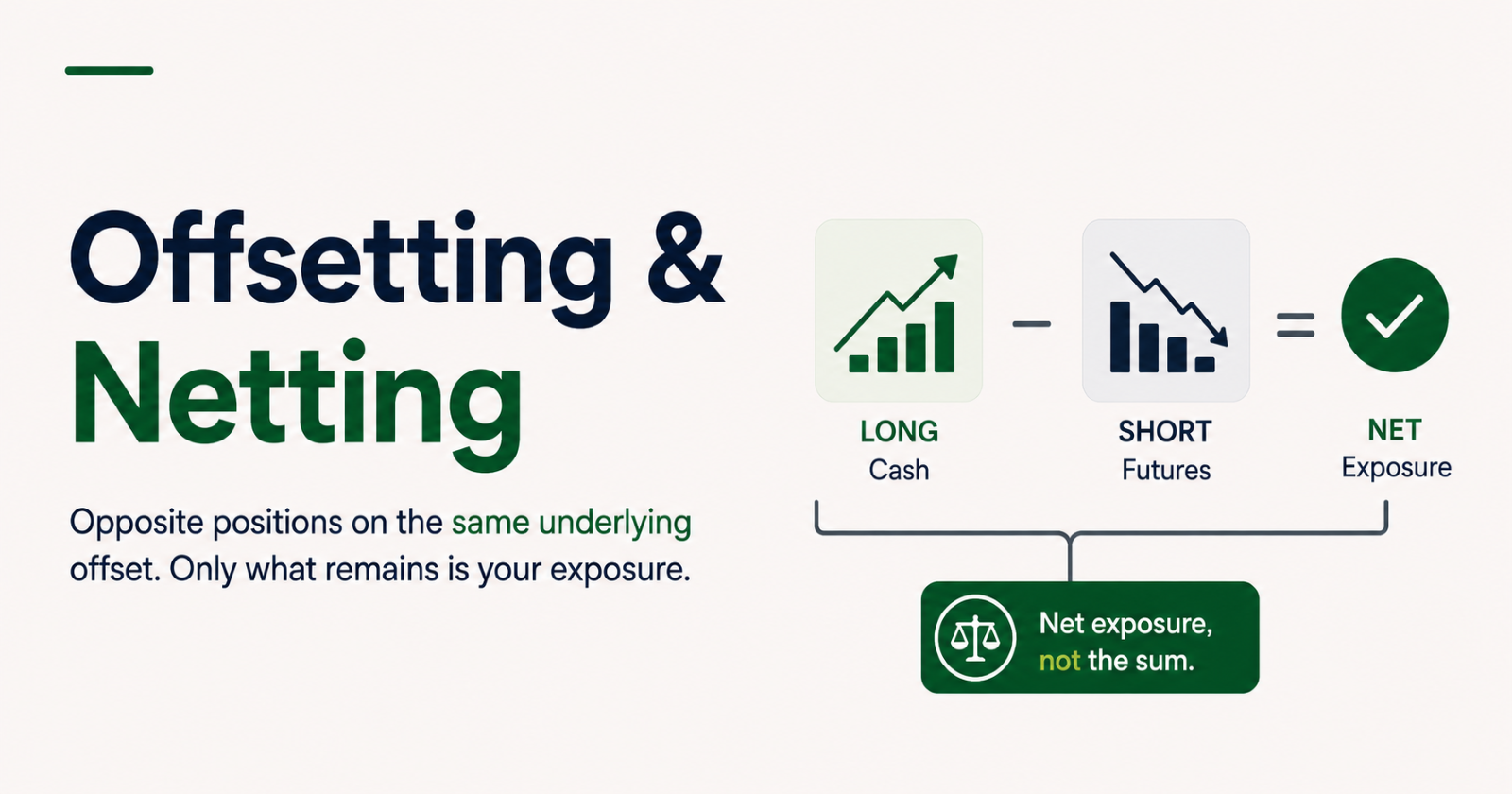
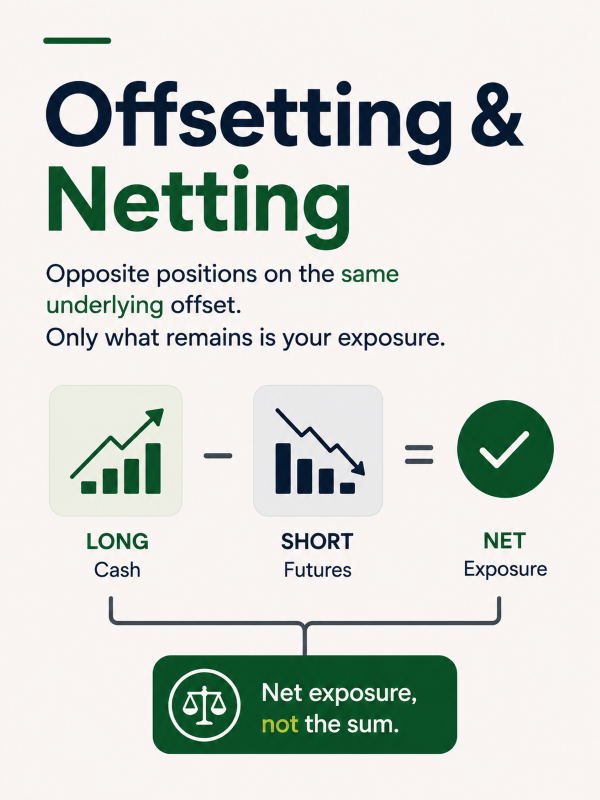
Offsetting is the process of netting opposite positions on the same underlying security against each other when calculating total exposure. When a fund holds a stock in the cash market and also holds a short futures position on the same stock, those two positions partially or fully offset, the net exposure is what remains after they cancel, not the sum of both.
It is a portfolio accounting mechanism that prevents double-counting of risk and allows managers to construct complex positions without artificially inflating the exposure numbers.
When Does an SIF Manager Use This?
Offsetting becomes relevant any time a manager holds opposing positions on the same underlying, which in a long-short SIF strategy happens frequently by design.
The SEBI circular explicitly permits offsetting at the portfolio level in two specific situations. First, between a cash position and a derivative position on the same underlying security. Second, between two derivative positions on the same underlying security. Both conditions require the same underlying and for futures and options contracts specifically the same expiry date.
What offsetting does not permit is equally important. Two positions on different underlying securities cannot be offset against each other, even if they are in the same sector or highly correlated. A long position in Bank A and a short futures position in Bank B are counted separately.
How It Plays Out
Per the SEBI circular, the following offsetting scenarios are explicitly permitted and not permitted:
Permitted: Net exposure is the dominant position only:
Position 1 | Position 2 | Net Exposure Counted |
Equity Long | Futures Short | Equity Long only |
Equity/Futures Long | Call Option Short | Equity/Futures Long only |
Equity/Futures Long | Put Option Long | Equity/Futures Long only |
Futures Short | Call Option Long | Futures Short only |
Futures Short | Put Option Short | Futures Short only |
Call Option Long | Call Option Short | Call Option Short only |
Put Option Long | Put Option Short | Put Option Short only |
Not Permitted: Both positions counted separately:
Position 1 | Position 2 | Net Exposure Counted |
Equity Long | Futures Long | Both counted separately |
Equity/Futures Long | Call Option Long | Both counted separately |
Equity/Futures Long | Put Option Short | Both counted separately |
Futures Short | Call Option Short | Both counted separately |
Futures Short | Put Option Long | Both counted separately |
Call Option Long | Put Option Short | Both counted separately |
Call Option Short | Put Option Long | Both counted separately |
The logic running through the permitted column is consistent: offsetting is only allowed when the two positions work against each other where one gains when the other loses on the same underlying. When both positions move in the same direction like two longs, or a short combined with another instrument that amplifies the short, they are additive in risk, not offsetting, and must be counted separately.
A practical example: SIF holds Stock A worth ₹10 crore in the cash market and shorts Stock A futures worth ₹8 crore. Without offsetting, gross exposure = ₹18 crore. With offsetting, net exposure = ₹2 crore long. The gross exposure calculation after offsetting is dramatically lower, freeing up room within the 100% net assets ceiling for other positions.