
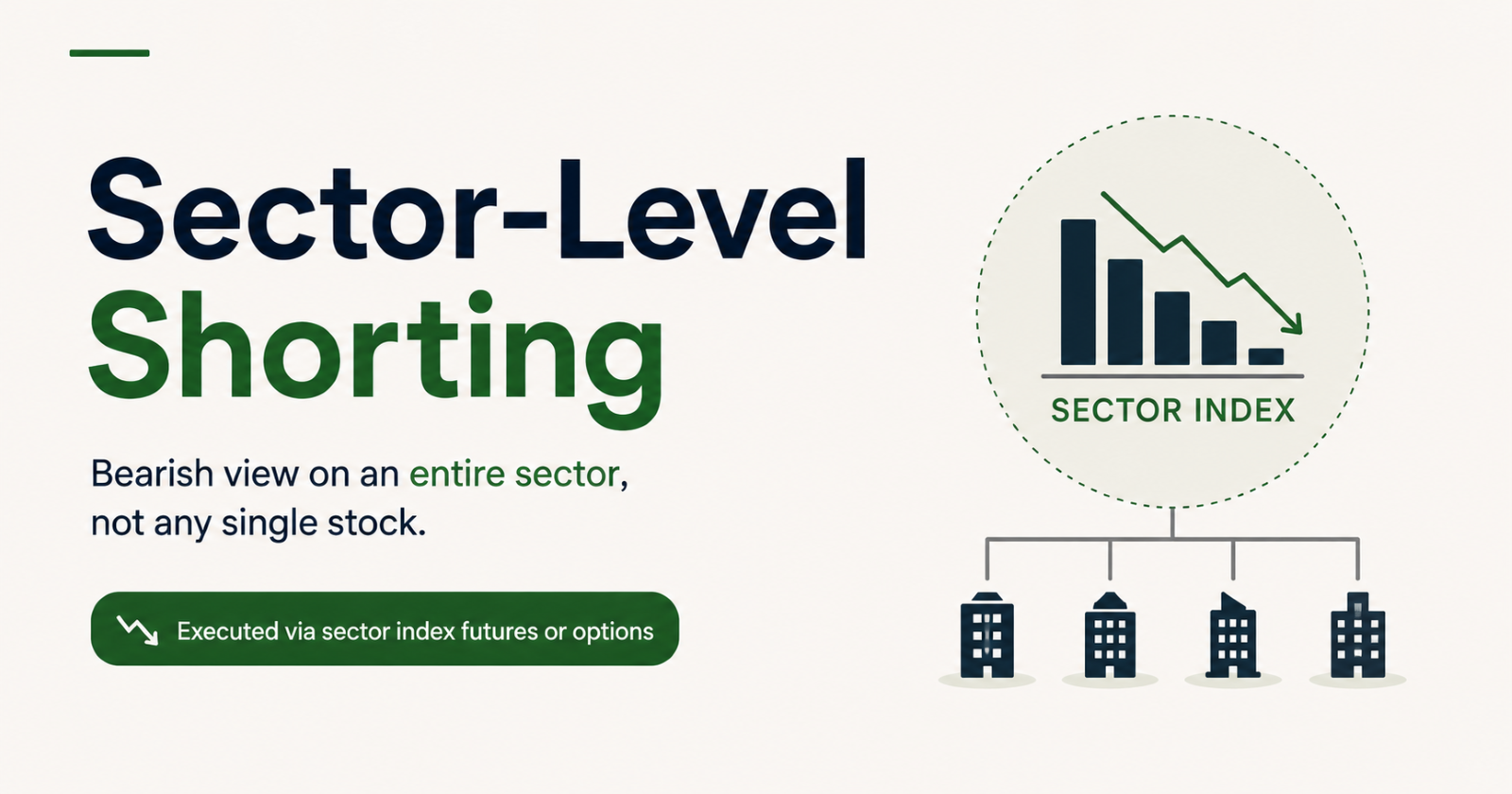
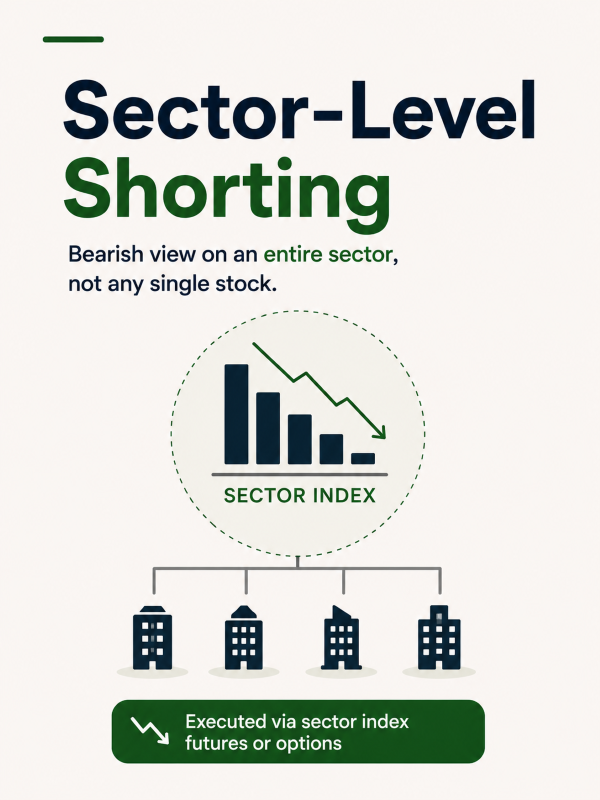
Most short positions target a specific stock i.e. a single company the manager believes is overvalued, poorly managed, or facing specific headwinds. Sector-level shorting takes a broader view. Instead of picking one stock to short, the manager shorts an entire sector, expressing a bearish view on the collective prospects of an industry rather than any individual company within it.
In practice, this is executed through index futures or options on sector indices, instruments that track the performance of a basket of stocks within a specific industry such as banking, pharma, auto, or IT. When the sector index falls, the short position gains. When it rises, the short position loses.
When Does an SIF Manager Use This?
A manager uses sector-level shorting when they have a strong negative view on an entire industry's near-term prospects, driven by macro factors, regulatory headwinds, commodity price pressures, or structural demand shifts but does not want to short individual stocks within that sector.
Common triggers include: a rate-sensitive sector facing an unexpected rate hike cycle, an export-oriented sector facing currency headwinds, a commodity-dependent sector facing raw material price spikes, or a regulated sector facing an adverse policy change.
The short exposure through sector-level shorting counts toward the 25% unhedged short limit permitted under the SIF framework.
How It Plays Out
Setup: SIF fund with ₹100 crore AUM. Manager holds Auto sector stocks worth ₹30 crore in the long book but turns bearish on the sector. Shorts the Auto sector index futures, ₹25 crore worth, representing the full 25% unhedged short limit. Per the SEBI rule, all Auto stocks in the portfolio are now treated as short positions.
Scenario | Long Book; Auto Stocks (₹30 cr) | Short; Auto Sector Futures (₹25 cr) | Net Impact |
Auto sector falls 20% | Loses ₹6 crore | Gains ₹5 crore | Near neutral (short largely protects) |
Auto sector falls 30% | Loses ₹9 crore | Gains ₹7.5 crore | Small net loss |
Auto sector rises 15% | Gains ₹4.5 crore | Loses ₹3.75 crore | Near neutral (upside largely surrendered) |
Auto sector rises 25% | Gains ₹7.5 crore | Loses ₹6.25 crore | Small net gain due to long book slightly larger |
Sector flat, stock-specific gains | Individual stocks gain | Futures flat | Stock alpha captured with sector hedge in place |
The last row is particularly instructive. If the manager holds high-quality Auto stocks that outperform the sector index, even while the sector stays flat the short on the index does not hurt while the individual stock gains come through. This is where sector-level shorting and stock selection work together rather than against each other.
The gap between the long book (₹30 crore) and the short position (₹25 crore) in the setup above is intentional, the short does not fully cover the long. A complete hedge would require shorting the full ₹30 crore, but that would exceed the 25% unhedged short limit.