
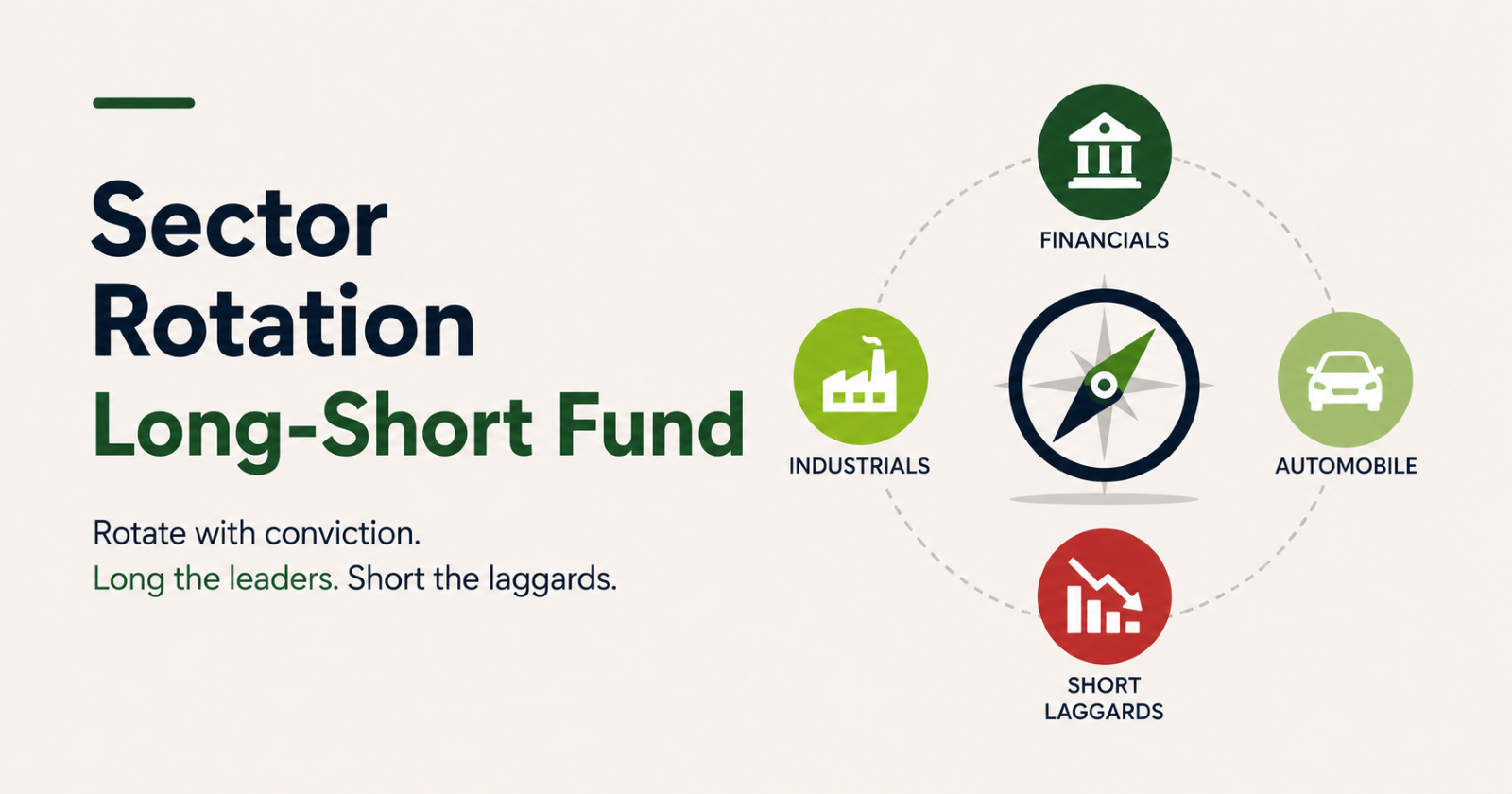
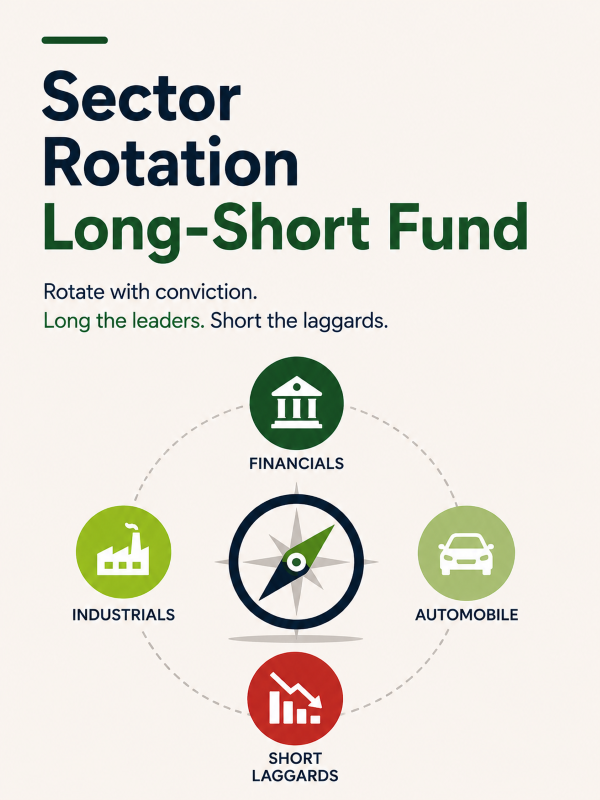
Every seasoned equity investor knows the feeling. You read the news, you see the cycle turning, i.e., IT spending is slowing, auto demand is picking up, banking stress is building, and you wonder why your mutual fund is still holding the same sector weights it held six months ago. Traditional funds rotate slowly, constrained by diversification mandates and the inability to act on bearish sector views.
The Sector Rotation Long-Short Fund is built for exactly this kind of conviction.
What This Fund Does Differently
This strategy concentrates a minimum of 80% of the portfolio in a maximum of four sectors, making it one of the most concentrated mandates in the SIF framework. The fund manager is essentially making a high-conviction macro call: these four sectors will outperform, and the portfolio reflects that bet without dilution across 10–12 sectors.
On the short side, the fund can take unhedged derivative positions of up to 25% of net assets, but with a critical rule: short exposure is applied at the sector level. If the manager shorts the Auto sector, every Auto stock held in the portfolio must be a short position. You cannot selectively short one Auto stock while holding another long.
At first glance, the sector-wide short rule seems restrictive. But it prevents a specific kind of portfolio manipulation, where a manager takes a notional "sector short" while cherry-picking long positions within the same sector, effectively neutralising the short and gaming exposure calculations. It forces genuine conviction rather than hedged ambiguity.
Where This Strategy Shines
Sector rotation is one of the most well-documented return patterns in equity markets. Different sectors lead at different points in the economic cycle, like financials in early recovery, industrials in expansion, defensives in slowdown. A manager who correctly anticipates these shifts and can also profit from sectors heading into decline has a structurally superior edge over a diversified fund that must hold everything.
This is a high-conviction, concentrated fund. Four sectors means if two of those sector calls are wrong, the damage is significant. This is not a strategy for investors who want smooth, consistent NAV movement. The short book provides some cushion by letting the manager profit from sectors in decline, but concentration risk remains the dominant feature of this strategy.