
Every investment carries risk. The real question is never whether risk exists, as it just always does, but whether you understand the specific risk you are taking on. For mutual funds, SEBI created the Riskometer to help investors visualise this. For Specialized Investment Funds, SEBI has introduced something similar but more nuanced: the Risk-Band.
If you are considering investing in an SIF, understanding how the Risk-Band works is not optional.
Risk Bands in SIF
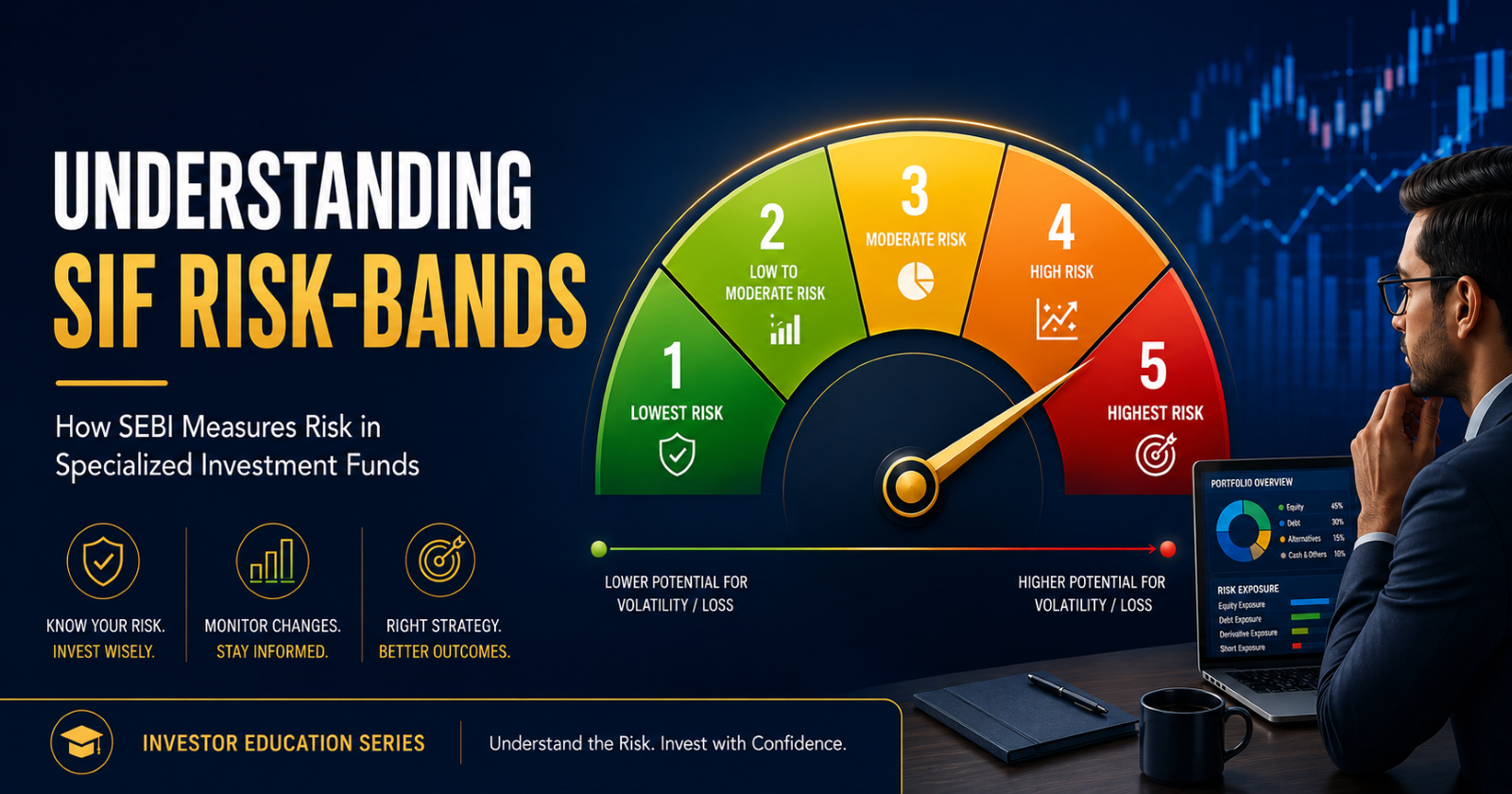
A Risk-Band is a pictorial risk indicator assigned to every investment strategy launched under an SIF. It tells you how much risk the strategy is taking on at any given point, based on its current portfolio, including its equity holdings, debt instruments, derivative positions, and short exposures.
It is not a one-time label applied at launch and forgotten. It is a living indicator that is reviewed and updated regularly.
The Five Levels of Risk-Band
The Risk-Band operates on a five-level scale:
Risk Band Level 1 sits at the lowest end of the spectrum. Strategies at this level carry the least potential for volatility or capital loss. Think conservative debt-oriented strategies with minimal derivative exposure.
Risk Band Level 2 represents low to moderate risk with slightly more active strategies that may have some exposure to market instruments beyond plain debt.
Risk Band Level 3 sits in the middle. Strategies here have a meaningful mix of instruments and some degree of derivative or short exposure, but are not at the aggressive end of the spectrum.
Risk Band Level 4 indicates higher risk. These strategies are likely to have significant derivative exposure, active short positions, or concentrated sector bets.
Risk Band Level 5 is the highest risk level. Strategies here are the most aggressive with maximum derivative and short exposure, dynamic allocation across multiple asset classes, and the highest potential for both gains and losses.
How Often is the Risk-Band Updated?
The Risk-Band is evaluated on a monthly basis. Within 10 days of the close of each month, every SIF and AMC is required to disclose the updated Risk-Band for all their investment strategies on their own website and on AMFI's website.
Additionally, every year as of March 31, SIFs must disclose not just the current risk level but also how many times the risk band changed over the past year. This annual disclosure is particularly useful to know whether the strategy has been consistently managed within a certain risk range or whether it has been swinging between levels throughout the year.
If an SIF strategy's risk band changes, the AMC is required to communicate this to existing unitholders through two channels: a formal Notice cum Addendum and a direct email or SMS to every investor in that strategy.
How to Use the Risk-Band as an Investor
Before investing, check the current Risk-Band of the strategy and compare it with your own risk tolerance. A Risk Band 5 strategy is not suitable for someone who cannot stomach significant capital drawdowns, regardless of how compelling the return narrative sounds.
After investing, monitor the monthly updates. And when you look at the annual disclosure of how many times the risk band has changed, use it to judge consistency. A strategy that has moved between levels four or five times in a year is being managed very actively, which may indicate that the fund manager is taking on risk opportunistically in ways you may not be comfortable with.